
Product Size Consolidation

Prevented revenue loss and preserved SEO, analytics, and marketing integrity by redefining size-variant architecture and UI
👤

Client

Publix

📅

Timeline

~8–12 weeks (est.)

⏱️

Year

2025

🎨

Role

Lead Designer

🎯

Context & Challenge

Size Consolidation Challenges

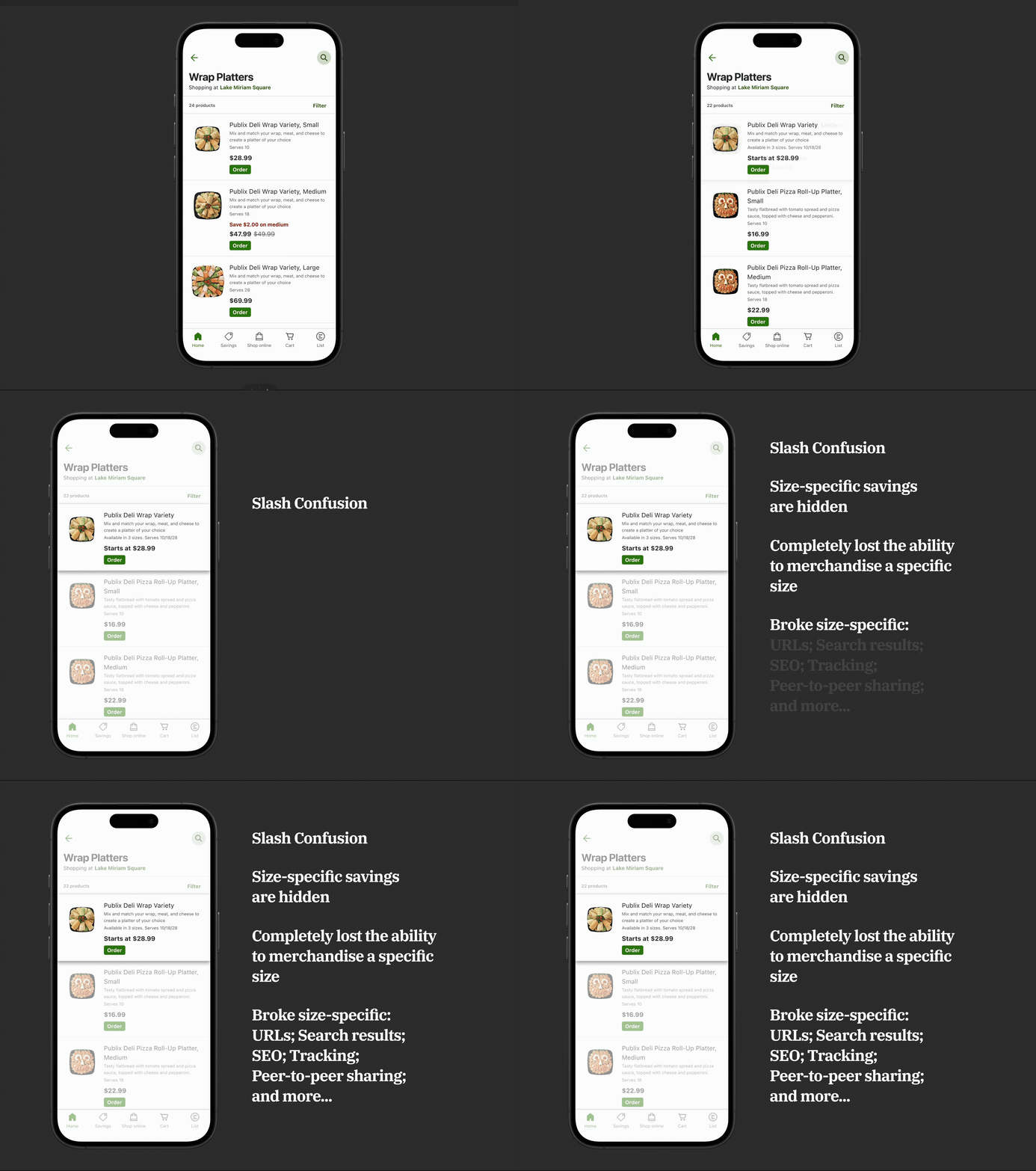
Engineering initiated a test to consolidate size variants (Small, Medium, Large) into a single product card, allowing customers to select size on the PDP instead of navigating separate product pages.

While the concept had clear UX potential—reducing redundancy and simplifying browsing—the execution introduced critical issues across both the frontend experience and backend architecture.

Most notably, all size variants were collapsed under a single ProductID, removing unique identifiers for Medium and Large sizes.

What initially appeared to be a UI simplification revealed a much larger problem: the change disrupted core systems supporting SEO, paid media, analytics, and customer navigation, creating significant risk to revenue and platform stability.

💡

Research

Reviewing the test implementation uncovered three critical gaps:

Key Findings

The solution did not align with customer mental modelsUnlike subs, catering sizes represent fundamentally different use cases (serving different group sizes), not interchangeable variations.Collapsing sizes into a single entity overlooked this distinction, creating confusion in how customers evaluate options.
Breaking product identifiers created downstream system failuresCollapsing sizes under a single ProductID removed unique URLs and identifiers for Medium and Large variants.This resulted in:Broken marketing and paid media linksLoss of SEO value and indexed pagesInability to track size-level performanceDisruptions to internal tools and reporting systems
Short-term consistency introduced long-term scalability riskThe approach attempted to reuse an existing pattern (subs), but did not account for differences in product structure.Without a flexible model, the system could not support both UX simplification and business-critical requirements, creating risk if scaled further.

These findings revealed that the problem was not just UI—it was a misalignment between frontend experience, backend architecture, and customer intent.

Solution

To address both immediate usability issues and long-term system risks, I proposed a solution that balanced UX clarity with architectural integrity.

This approach ensured we could simplify the experience without compromising the systems that drive revenue and performance.

Short-Term UI ImprovementsQuick updates to improve clarity and scannability in the live test:ImpactImproved visibility of size optionsReduced risk of misinterpretationEnabled clearer promotion of size-based pricing
Validated Long-Term UI DirectionExplored and tested multiple product card variations to ensure customers could easily understand size options.Impact100% recognition of multiple sizes across prototypesHigh confidence scores (4.8–5.0 / 5)Identified scalable UI patterns without adding engineering overhead
Scalable Catalog ArchitectureDefined a new structure that preserves system integrity while enabling flexible UI patterns:Maintain unique ProductIDs and URLs for each sizeIntroduce a parent grouping attribute for logical associationImpactPreserves SEO, analytics, and deep-linkingEnables flexible UI (single card or multiple cards)Creates a scalable foundation for future products
🔑

Key Design Decisions

💭

Reflections

This project reinforced that small UI changes can have significant system-level consequences.

What initially appeared to be a simple UX improvement surfaced deeper dependencies across analytics, marketing, SEO, and backend architecture.

By addressing both the user experience and underlying system design, we ensured the solution not only improves usability—but also protects and enables long-term business performance.

What I’d Do Differently

  • Validate architectural implications earlier before testing UI changes
  • Align more closely with engineering on system dependencies upfront
  • Define success metrics prior to test implementation
← Back to portfolio